The Stop That Survives
The stop does not go "X points away". It goes where your trade is invalidated. Learn this and you stop turning winners into losers.
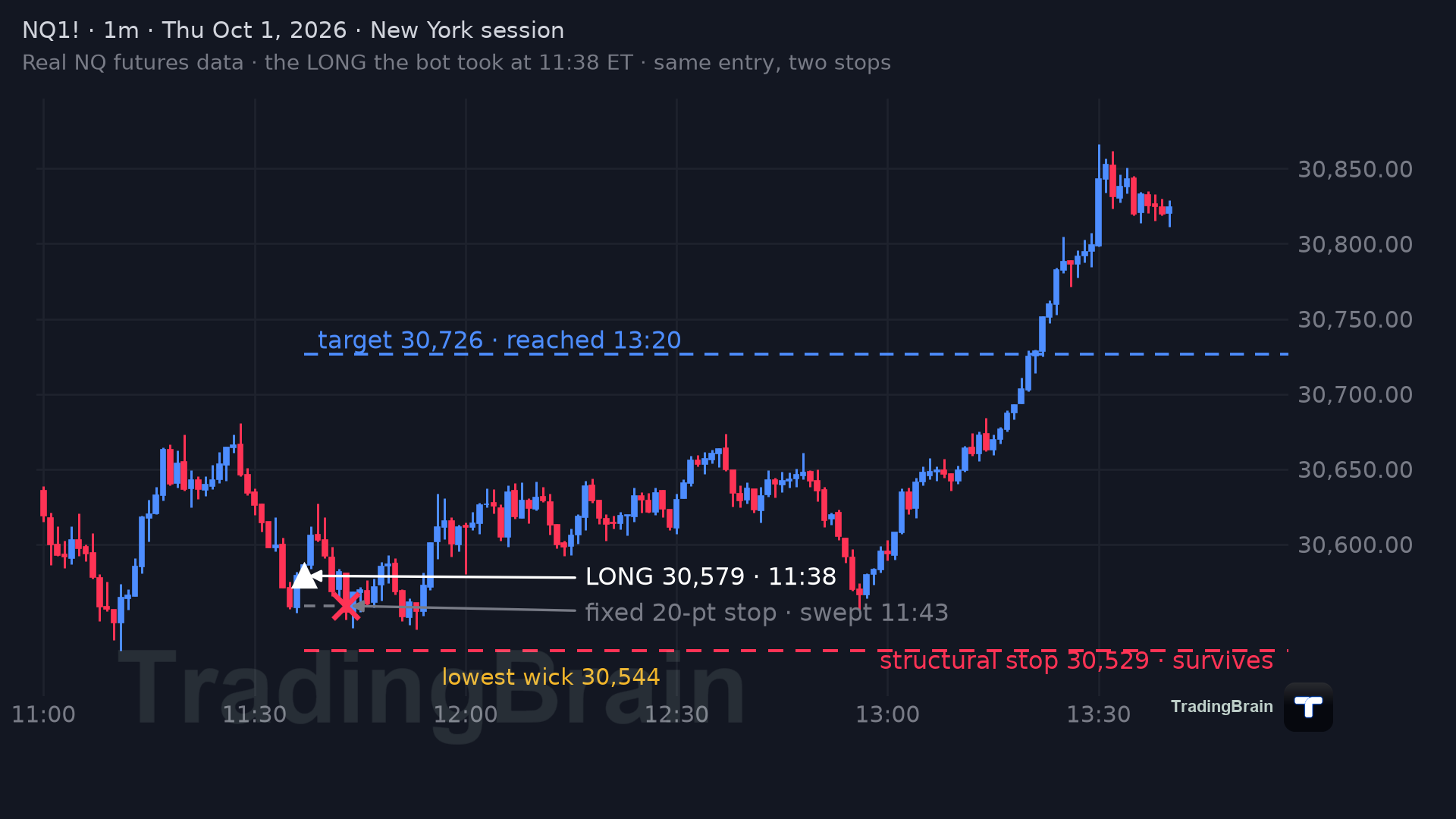
1 The fixed-stop trap
Always using "20 points" is donating your account. In a volatile open, 20 points is noise — it gets swept and price continues in your favor without you on board.
2 Where the stop actually goes
Behind the structure that invalidates your idea. If you entered at an Order Block and price closes on the far side of that OB → your idea is dead — that's your stop. Not one tick earlier (the wick takes you), not randomly far away (you risk too much).
3 Why you get stopped with the right direction
Because the stop sat in the wick, not behind the structure. The market seeks that liquidity (your stop), takes it, and continues in your direction — without you. A stop placed behind the real structure survives that wick.
4 The rule that fixes it
If your stop has to be huge to "survive", your entry is misplaced. A good stop is the consequence of a good entry — not a patch for a bad one. Reposition the entry at the proper POI instead of widening the stop.
The stop is not a distance — it's a location. Put it behind the structure that would prove your idea wrong, and a stop-hunt wick can't touch it. If it needs to be huge to survive, fix the entry, not the stop.